
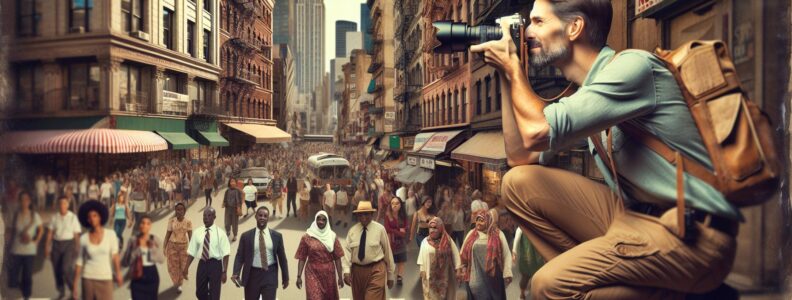
Street photography captivates us with its raw authenticity and ability to freeze fleeting moments in time. While it’s often associated with urban streets, this dynamic art form extends far beyond city sidewalks – from bustling museums and metro stations to serene beaches and hidden alleyways. It’s not just about capturing people; it’s about documenting human presence and storytelling through images.
We often debate whether strict rules should govern street photography, as it’s fundamentally an art of personal expression and style. The beauty of this genre lies in its flexibility – photographers can pursue documentary-style realism, create abstract interpretations, or capture those wonderfully serendipitous moments that exist for just a split second. Let’s explore three essential guidelines that can help elevate your street photography while maintaining creative freedom.
Understanding Street Photography Basics
Street photography embraces imperfections to capture authentic, unplanned moments in daily life. Three fundamental rules guide this artistic discipline while allowing creative freedom.
Equipment and Camera Settings
Street photography relies on lightweight, unobtrusive equipment for maximum mobility. Here’s what to consider:
Camera Setup:
- Set ISO between 400-800 for flexibility in various lighting conditions
- Use aperture priority mode (f/8 to f/16) for adequate depth of field
- Enable auto-focus with center-point focusing
- Keep shutter speed at 1/250 or faster to freeze motion
Essential Gear:
- Small mirrorless or compact camera
- Single prime lens (35mm or 50mm equivalent)
- Extra battery
- Memory card
| Setting | Recommended Range | Purpose |
|---|---|---|
| ISO | 400-800 | Balance light sensitivity |
| Aperture | f/8-f/16 | Maintain focus depth |
| Shutter | 1/250+ | Prevent motion blur |
- Zone focusing technique for quick shots
- Manual focus preset at 8-10 feet
- Raw format for post-processing flexibility
- Silent shutter mode when available
This minimalist approach allows photographers to focus on composition rather than equipment, creating authentic street scenes without drawing attention to themselves.
Rule 1: Master Composition and Distance

Mastering composition and distance establishes the foundation for compelling street photography. The interplay between proximity and framing creates images that resonate with viewers.
Getting Close to Your Subjects
A wide-angle lens operating at 12-24mm enables intimate street photography compositions. Getting physically closer to subjects creates a more immersive viewing experience. Here’s how to approach close-up street photography:
- Set camera settings before shooting to minimize drawing attention
- Work at the 12mm focal length for environmental context
- Practice zone focusing to shoot without looking through the viewfinder
- Maintain natural expressions by shooting with the subject’s awareness
- Use fill-flash techniques once comfortable with close proximity
Working With Backgrounds
Background elements add depth and context to street photographs when composed thoughtfully. Key background composition techniques include:
- Frame subjects against clean walls to eliminate distractions
- Incorporate architectural elements to create leading lines
- Position subjects where background patterns complement the scene
- Use doorways or arches to naturally frame the main subject
- Leave negative space to emphasize the subject’s environment
| Distance Range | Lens Choice | Effect on Image |
|---|---|---|
| 1-3 feet | 12mm | Intimate environmental portraits |
| 3-6 feet | 18mm | Balance of subject and context |
| 6-10 feet | 24mm | Fuller scene incorporation |
The proximity to subjects directly influences viewer engagement with the final image. Working close creates dynamic compositions while preserving candid moments through confident approach and technical preparation.
Rule 2: Timing and Anticipation

Successful street photography relies on the photographer’s ability to predict and capture fleeting moments. The art of timing transforms ordinary scenes into extraordinary photographs through patient observation and quick reaction.
Capturing the Decisive Moment
Street photographers create compelling images by keeping their eyes open to the environment instead of staying fixed behind the camera. Taking the camera away from your eye between shots enhances awareness of the surroundings, making it easier to spot potential moments. Direct observation helps identify promising scenes before raising the camera to capture them.
Reading People and Movements
Understanding human behavior patterns enables photographers to anticipate potential photo opportunities. Here’s how to read and predict street moments:
- Watch for repeated actions like people crossing streets or entering doorways
- Observe natural gathering points such as street corners cafes or bus stops
- Notice environmental factors that influence movement patterns like traffic lights or store entrances
- Position the camera slightly off-center initially then adjust quickly for the final shot
- Monitor body language cues that signal upcoming actions or interactions
- Study light patterns throughout the day to predict where subjects might pause or gather
The key lies in appearing to photograph the background while waiting for subjects to enter the frame. This technique helps maintain discretion while capturing authentic moments. Pre-visualizing the scene allows photographers to position themselves strategically before pressing the shutter.
| Timing Element | Impact on Photography |
|---|---|
| Pre-visualization | 80% of successful captures |
| Response speed | Under 2 seconds |
| Scene observation | 15-20 minutes per location |
| Subject movement | 3-5 seconds window |
Rule 3: Ethics and Legal Considerations

Street photography requires a delicate balance between artistic expression and ethical responsibility. Understanding legal rights and respecting personal boundaries creates a foundation for responsible street photography practice.
Photography Rights in Public Spaces
In public spaces like streets, parks and sidewalks, photographers maintain the legal right to capture images without obtaining consent. Here’s what defines legal street photography practices:
- Photograph freely in public areas where subjects lack reasonable expectation of privacy
- Capture images of buildings, landmarks and architectural elements without restriction
- Document public events, gatherings and street scenes from publicly accessible locations
- Use photos for artistic or editorial purposes without model releases in most cases
| Location Type | Photography Rights |
|---|---|
| Public Streets | Fully Permitted |
| Parks & Plazas | Fully Permitted |
| Private Property | Permission Required |
| Restricted Areas | Not Permitted |
Respecting Privacy and Boundaries
Ethical street photography extends beyond legal rights to consider the dignity and comfort of subjects:
- Keep appropriate physical distance when photographing subjects
- Avoid capturing private moments or conversations
- Use creative techniques like silhouettes, shadows or partial frames to maintain anonymity
- Photograph from behind or obscure identifying features when appropriate
- Focus on incidental human presence rather than identifiable individuals
- Remain unobtrusive and discrete while photographing
- Stop photographing if someone explicitly objects
- Consider cultural sensitivities and local customs regarding photography
The key lies in balancing creative expression with ethical considerations – photographing legally while respecting personal boundaries through thoughtful approaches and techniques.
Conclusion
These three fundamental rules serve as our compass in street photography while leaving room for artistic interpretation. By mastering composition and distance getting our timing right and respecting ethical boundaries we’re well-equipped to capture compelling street scenes.
Remember that rules in street photography aren’t rigid constraints. They’re guidelines that help us develop our creative vision and personal style while maintaining respect for our subjects and surroundings. Whether we’re seasoned photographers or just starting out these principles will guide us toward creating meaningful authentic street photographs.