In today’s competitive digital landscape, finding the right visuals is just as important as crafting compelling content. For content marketers, effective stock photo keyword research is essential to discover high-quality images that align with brand messaging and audience intent. By using the right keywords, marketers can save time, improve relevance, and enhance overall campaign performance.
Why Keyword Research Matters for Stock Photos
Stock photo platforms rely heavily on keyword tagging and search algorithms. Whether you are browsing on Shutterstock or similar platforms, the right keywords determine the quality and relevance of your search results. Poor keyword selection can lead to generic or mismatched visuals, while well-researched keywords help you uncover unique, high-performing images.
For content marketers, this means better storytelling, improved engagement, and stronger visual consistency across campaigns.
Understanding Search Intent
Before typing keywords into a stock platform, it’s important to understand search intent. Ask yourself:
What message should the image convey?
Who is the target audience?
What emotion or action should the visual inspire?
For example, instead of searching for “business,” refine your query to “remote team collaboration,” “startup meeting,” or “digital marketing strategy.” These targeted phrases yield more relevant and modern visuals.
Use Descriptive and Layered Keywords
Effective keyword research involves combining broad and specific terms. This technique, often called “layered keywording,” improves search accuracy.
Broad Keywords: business, technology, health Specific Keywords: diverse team brainstorming, AI data analytics dashboard, home workout routine
Adding modifiers such as location, mood, demographics, and actions can further refine results. For example:
“young entrepreneur working laptop cafe”
“happy family outdoor sunset lifestyle”
This approach helps you find images that feel authentic rather than staged.
Leverage Platform Suggestions
Most stock platforms, including Shutterstock, provide auto-suggestions and related keywords when you search. These suggestions are based on popular queries and trending content, making them valuable for marketers.
Additionally, browsing similar images and reviewing their tags can reveal keyword opportunities you might not have considered. This is especially useful when working within a specific niche or campaign theme.
Align Keywords with SEO Strategy
Stock photo keyword research should complement your broader SEO strategy. If your blog or landing page targets specific keywords, try to align your image searches with those terms.
For instance, if your article targets “email marketing automation,” use similar keywords when searching for visuals. This creates a cohesive content experience and can improve on-page SEO through optimized image alt text and filenames.
Optimize Your Workflow with the Right Plan
Access to a wide variety of assets is crucial for consistent content production. Choosing the right Shutterstock plan ensures you can download and test multiple visuals without limitations. This flexibility allows marketers to experiment with different keyword combinations and creative directions.
Common Mistakes to Avoid
Many marketers make the mistake of using overly generic keywords or ignoring context. Avoid:
Single-word searches that lack specificity
Outdated terms that don’t reflect modern trends
Ignoring cultural or regional relevance
Instead, stay updated with visual trends and adapt your keyword strategy accordingly.
Conclusion
Stock photo keyword research is a critical skill for content marketers aiming to elevate their visual storytelling. By understanding search intent, using layered keywords, leveraging platform tools, and aligning with SEO goals, you can consistently find high-quality images that enhance your content. With the right approach—and the support of a suitable Shutterstock plan—you’ll streamline your workflow and create more impactful marketing campaigns.
When I first started creating content for my business, finding high-quality images was a constant challenge. That’s when I discovered the world of stock photos—professional, ready-to-use images available for purchase online that instantly elevated my visual content.
Buying stock photos offers numerous advantages for content creators, marketers, and business owners alike. From saving time on photoshoots to gaining access to millions of professional images at affordable prices, stock photography has revolutionized how we source visual content. I’ve found that using properly licensed stock images also protects my business from potential copyright infringement issues that can arise from using random images found online.
What Are Stock Photos and Why You Might Need Them
Stock photos are professional photographs available for licensing for specific uses. These high-quality images cover countless subjects and styles, from business professionals in meetings to breathtaking landscapes and abstract concepts. Unlike custom photography, stock photos are ready-made, pre-shot images that anyone can license and use immediately.
When I first started creating content, I quickly realized that finding appropriate visuals was challenging. Stock photos solved this problem by providing instant access to professional-quality images without the hassle of scheduling photo shoots or hiring photographers.
The stock photo industry works on a simple premise: photographers create images and upload them to stock photo websites, where businesses and individuals can buy licenses to use these images. This creates a win-win situation where photographers earn income from their work, and users gain access to professional visuals without significant upfront investment.
There are several compelling reasons to buy stock photos:
Time efficiency: Finding and downloading the perfect stock photo takes minutes compared to days or weeks for custom photography
Cost-effectiveness: Stock photos typically cost between $1-$15 per image, while custom photography can run hundreds or thousands of dollars
Variety and selection: Major stock sites offer millions of images across every conceivable category and style
Professional quality: Stock photos are created by skilled photographers using professional equipment
Legal protection: Licensed stock photos include proper rights clearance, protecting you from copyright claims
For anyone creating websites, marketing materials, social media content, or blogs, stock photos have become an essential resource. They provide the visual impact needed to capture attention in today’s image-driven digital landscape.
Top Platforms to Buy Stock Photos
After discovering the value of stock photos for my business, I’ve identified several reliable platforms where you can buy stock photos with confidence. Each service offers unique benefits for different creative needs and budgets.
Shutterstock
Shutterstock stands as one of the most comprehensive resources to buy stock photos online. With over 400 million images in their collection, they provide exceptional variety across categories like business, nature, lifestyle, and technology. Their subscription plans start at $29 monthly for 10 downloads, making them accessible for both occasional users and professionals needing regular content. I particularly appreciate their powerful search filters that help narrow down results by orientation, color, people, and composition elements. Shutterstock’s straightforward licensing terms ensure images can be used confidently across multiple projects without legal concerns.
Adobe Stock
Adobe Stock integrates seamlessly with Creative Cloud applications, making it my go-to choice when working on design projects. Their library contains over 300 million stock photos that can be accessed directly within Photoshop, Illustrator, and InDesign. This workflow integration saves considerable time when creating marketing materials or web content. Adobe offers flexible pricing options starting at $29.99 monthly for 10 images, with annual plans providing better value. Their curated collections feature contemporary, on-trend imagery that keeps content looking fresh and relevant. The platform’s visual search feature lets me upload similar images to find exactly what I need.
iStock by Getty Images
iStock delivers premium stock photos with exceptional quality and artistic merit. As a Getty Images company, iStock maintains high standards while offering more affordable options than their parent brand. Their signature collection includes exclusive, rights-managed content not available elsewhere. Credit packs start at $12 per image, while subscription plans begin around $29 monthly for 10 downloads. I’ve found their authentic lifestyle imagery particularly valuable for creating relatable content. iStock excels at providing diverse representation in their stock photos, featuring models of various ethnicities, ages, and body types—perfect for inclusive marketing campaigns.
Depositphotos
Depositphotos offers some of the most competitive prices for high-quality stock photos in the industry. Their library features over 220 million images with straightforward licensing options. For budget-conscious projects, their subscription plans start at just $9.99 monthly. Despite offering cheap stock photos, they maintain impressive quality standards with detailed search functionality. Depositphotos’ flexible on-demand plans let me purchase images individually without commitment. Their Extended License option provides additional usage rights for merchandise, templates, and high-volume reproduction. I frequently use their seasonal collections for timely content creation that resonates with current trends and holidays.
Understanding Stock Photo Licensing Options
When you buy stock photos, understanding the licensing terms is crucial to avoid legal complications. Stock photo licenses dictate how and where you can use the images you purchase, with different options offering varying levels of flexibility and protection.
Royalty-Free vs. Rights-Managed
Royalty-free licenses are the most common option when purchasing stock photos. With a royalty-free license, I pay once and can use the image multiple times across various projects without additional fees. For example, I can use the same stock photo on my website, social media, and in marketing materials without paying again. This flexibility makes royalty-free licenses popular for bloggers, small businesses, and content creators needing cost-effective visual solutions.
Rights-managed licenses function differently, providing more exclusive usage rights but with stricter limitations. These licenses specify exactly how, when, where, and for how long the stock photos can be used. A rights-managed license might restrict usage to a specific geographic region, time period, or medium. While typically more expensive than royalty-free options, rights-managed licenses offer exclusivity – competitors can’t use the same image in a similar way during your license period. This option is ideal for high-profile advertising campaigns or brand-sensitive materials where image uniqueness matters.
Standard vs. Extended Licenses
Standard licenses cover most common uses when you buy stock photos. These licenses typically allow for website use, blog posts, social media, internal presentations, and personal projects. Standard licenses come with usage limitations, including maximum impression counts (often 500,000) and restrictions against merchandise creation or items for resale. For most digital content creators, standard licenses provide sufficient coverage at affordable prices.
Extended licenses offer broader usage rights for stock photos, permitting commercial applications beyond standard license restrictions. With an extended license, I can create products for resale such as t-shirts, mugs, digital templates, or print-on-demand items. These licenses also typically remove impression caps and allow unlimited distribution. While extended licenses cost significantly more than standard options, they’re essential for e-commerce businesses, product designers, and companies creating commercial merchandise. On platforms like Shutterstock or Adobe Stock, extended licenses might cost 5-10 times more than standard licenses but provide valuable legal protection for commercial ventures.
How to Choose the Right Stock Photos for Your Project
Define Your Purpose and Audience
Selecting the perfect stock photos begins with understanding my project’s purpose. I always ask myself what message I’m trying to convey before browsing through millions of stock photos. For a corporate website, I select professional, clean images that instill trust. For a lifestyle blog, I opt for authentic, relatable scenes. The target audience significantly influences my choices—younger audiences typically respond to bright, dynamic imagery, while professional audiences prefer more subdued, sophisticated visuals.
Focus on Quality and Resolution
When I buy stock photos, image quality is non-negotiable. I always check the resolution before purchasing, ensuring it meets my specific requirements. For web use, I need images at least 1920px wide, while print projects require 300 DPI resolution. Poor quality stock photos reflect badly on my brand, so I examine details like sharpness, lighting, and composition before finalizing my purchase. Platforms like Shutterstock and Adobe Stock offer filtering options to find high-resolution images quickly.
Consider Authenticity and Diversity
Today’s audiences crave authenticity in visual content. I avoid overly staged or clichéd stock photos that appear artificial and opt for images that capture genuine moments. When selecting stock photos, I ensure they represent diverse people, cultures, and situations. Modern stock photo sites offer excellent diversity filters—iStock, for example, has dedicated collections featuring diverse representations across age, ethnicity, body types, and abilities.
Check for Consistency with Your Brand
My brand identity guides all my stock photo selections. I maintain visual consistency by choosing images with similar color palettes, styling, and mood that align with my brand guidelines. For example, if my brand uses muted tones and minimalist aesthetics, I select stock photos with similar characteristics. This consistency strengthens brand recognition and creates a cohesive visual experience across all materials.
Search Strategically
Finding the perfect stock photos requires effective search techniques. I use specific keywords rather than general terms to narrow results—instead of “business meeting,” I search for “diverse team brainstorming in modern office” to get more relevant options. Most quality stock photo platforms offer advanced filters for orientation, color schemes, negative space, and composition style. I also save time by creating collections of images that match my brand style for future projects.
Pricing Models and Subscription Options
When looking to buy stock photos, understanding the various pricing models helps maximize value for your budget. Stock photo websites offer different payment structures designed to accommodate diverse usage needs, from occasional purchases to frequent downloads.
Pay-Per-Image vs. Subscription Plans
Pay-per-image and subscription plans represent two fundamentally different approaches to purchasing stock photos. With pay-per-image pricing, I’ve found you pay for each image individually, typically ranging from $1-15 per photo depending on size and licensing terms. This model works perfectly for projects requiring just a few specific images or when you need high-quality stock photos for infrequent use. The advantage lies in paying only for what you need without recurring commitments.
Subscription plans, in contrast, offer significant savings for regular content creators. These monthly or annual packages provide a set number of downloads (typically 10-750 images monthly) at a substantially reduced per-image cost. For example, a subscription might cost $29-$249 monthly but bring the effective price down to less than $1 per image. Many platforms like Shutterstock and Adobe Stock offer tiered subscription options catering to different download volume needs. These plans create exceptional value when buying stock photos in bulk for content-heavy websites, social media campaigns, or agency work.
Credit-Based Systems
Credit-based systems offer a flexible middle ground between one-off purchases and subscriptions for buying stock photos. Under this model, you purchase credit packs upfront and spend these credits to download images of varying quality and size. Higher resolution stock photos typically require more credits than smaller, web-optimized versions.
This system provides several advantages. Credits usually don’t expire for 12 months, allowing for strategic purchase of cheap stock photos when platforms run promotions. The model eliminates monthly subscription pressure while still offering volume discounts compared to individual purchases. Platforms like iStock and Depositphotos implement credit systems effectively, with credit packs ranging from 10-1000 credits. For instance, a 100-credit pack might cost $80-130, with standard stock photos requiring 1-3 credits each. This approach works particularly well for businesses with fluctuating image needs or those who want to access premium stock photos image collections without committing to recurring payments.
Tips for Finding High-Quality Stock Photos Within Your Budget
Set Clear Search Parameters
Setting precise search parameters saves valuable time when looking for cheap stock photos. I’ve found that using specific keywords related to my project yields better results than generic terms. For example, searching “woman entrepreneur coffee shop laptop” instead of just “business woman” narrows results significantly. Most stock photo sites offer advanced filters for orientation (landscape vs. portrait), color schemes, number of people, and composition style. Applying these filters upfront eliminates scrolling through thousands of irrelevant images.
Take Advantage of Free Trials and Sample Packs
Many premium stock photo websites offer free trials or sample packs before committing to a paid plan. I regularly test new platforms through their trial periods, downloading high-quality images without immediate cost. Sites like Shutterstock and Adobe Stock typically provide 10-30 free downloads during trial periods. Some platforms also release monthly free photo packs—signing up for their newsletters ensures I never miss these opportunities. These free options provide professional-quality images while helping me evaluate if the platform meets my needs.
Consider Stock Photo Subscriptions for Bulk Needs
Stock photo subscriptions offer significant savings for regular content creators. When I calculated my annual image needs, I discovered a monthly subscription saved me 70% compared to individual purchases. Most platforms offer tiered subscriptions based on download volume—starting around $29/month for 10 images and scaling to $199/month for 750 images. The per-image cost drops dramatically with higher volume plans. For projects requiring numerous images, I’ve found quarterly or annual subscriptions provide the best value, often including additional features like extended licenses.
Explore Specialized Niche Marketplaces
Niche stock photo marketplaces often offer unique, high-quality images at lower prices than mainstream sites. I’ve discovered platforms specializing in specific industries like healthcare, technology, and education that provide contextually relevant photos at 20-40% lower costs. These specialized sites typically maintain smaller but highly curated collections, reducing search time and increasing relevance. For example, medical-focused stock sites offer authentic healthcare imagery that avoids the staged feel common on larger platforms.
Use Budget-Friendly Alternatives
Several budget-friendly alternatives exist for accessing quality stock photos without breaking the bank. Stock photo subscription services like Depositphotos and 123RF offer economy plans starting at $9.99/month. Pay-as-you-go options with credit packs provide flexibility for occasional users—typically ranging from $0.80-$3 per image depending on resolution needs. For unique projects with minimal commercial requirements, I sometimes use creative commons licensed images from platforms like Unsplash or Pexels, ensuring I understand the attribution requirements before publishing.
Optimize Usage Rights for Your Specific Needs
Understanding license limitations helps avoid overpaying for unnecessary rights. I always match my license purchase to my specific usage needs. Standard royalty-free licenses cover most digital marketing and website uses, while extended licenses become necessary for products sold for profit. For blog posts and social media content, standard licenses typically suffice, saving $50-100 per image compared to extended options. Before purchasing, I carefully review licensing terms regarding audience size, distribution channels, and usage duration to ensure I’m not paying for permissions I don’t need.
Legal Considerations When Buying Stock Photos
When purchasing stock photos, understanding the legal framework is just as important as finding the perfect image. Legal compliance protects you from potential copyright infringement claims that can result in costly penalties and damage to your reputation.
Copyright Basics for Stock Photography
Copyright laws automatically protect photographs from the moment they’re created. When you buy stock photos, you’re not purchasing the copyright but obtaining a license to use the image under specific conditions. The original photographer or agency retains the copyright ownership. Most stock photo licenses prohibit:
Reselling or redistributing the image as-is
Using images for offensive or illegal content
Implying that models in the photos endorse specific products without a model release
Using editorial images for commercial purposes
I’ve learned that misunderstanding these basics is where many content creators inadvertently violate licensing terms when using stock photos.
Model and Property Releases
Stock photos featuring recognizable people or private property require special documentation. Model releases are signed agreements from individuals appearing in photos, giving permission for their likeness to be used commercially. Property releases serve a similar function for private property.
When buying stock photos with people or distinctive properties, always verify:
If the image includes proper model releases for commercial use
Whether property releases exist for recognizable private locations
If any restrictions apply to sensitive contexts (medical, political, or controversial topics)
Special requirements for images featuring minors
Most reputable stock photo sites indicate whether these releases are included, but it’s ultimately your responsibility to ensure compliance.
Commercial vs. Editorial Use
Stock photos are typically categorized for either commercial or editorial use. This distinction significantly impacts how you can legally use the images:
News articles, blog posts about current events, textbooks
I’ve found that using editorial images for commercial purposes is one of the most common legal mistakes when buying stock photos. Even with a valid license, using an editorial image in advertising could expose you to lawsuits.
International Copyright Considerations
Copyright protection varies across countries, but most nations honor copyright laws through international treaties like the Berne Convention. When buying stock photos for global use, consider:
Different moral rights protections in European countries
Varying fair use provisions internationally
Local requirements for attribution
Country-specific restrictions on content or imagery
For websites with international audiences, I ensure my stock photo licenses explicitly cover worldwide usage to avoid cross-border legal complications.
Indemnification and Legal Protection
Quality stock photo sites offer indemnification protection—legal coverage if an image you’ve properly licensed results in a lawsuit. This protection varies significantly between providers:
Premium sites like Shutterstock and Adobe Stock typically offer $10,000+ in indemnification
Budget stock photo services might offer limited or no protection
Protection usually requires strict adherence to all license terms
Most indemnification doesn’t cover modified images or specific sensitive uses
I always review the indemnification terms when buying stock photos, especially for high-visibility projects where legal issues would be particularly damaging.
Documentation and Record-Keeping Practices
Maintaining records of your stock photo purchases is essential for legal protection. I keep detailed documentation including:
License certificates and purchase receipts
Screenshots of license terms at the time of purchase
Notes about how and where each image is used
Records of correspondence with the stock photo provider
Dates of download and implementation
This documentation provides critical evidence if questions about your right to use an image ever arise. I organize these records by project and store them securely with backups.
Conclusion
Stock photos have revolutionized how businesses and creators source professional visuals. They’ve saved me countless hours and budget compared to custom photography while protecting me from copyright issues.
Whether you choose Shutterstock’s vast library Adobe Stock’s seamless integration or budget-friendly alternatives the key is understanding your specific needs and the licensing terms that apply.
With the right approach you’ll find high-quality images that elevate your projects without breaking the bank. I’ve found that investing time in learning search techniques and comparing subscription options pays dividends in the long run.
Stock photography isn’t just convenient—it’s essential for creating professional content in today’s visual-first digital landscape.
Street photography captivates us with its raw authenticity and ability to freeze fleeting moments in time. While it’s often associated with urban streets, this dynamic art form extends far beyond city sidewalks – from bustling museums and metro stations to serene beaches and hidden alleyways. It’s not just about capturing people; it’s about documenting human presence and storytelling through images.
We often debate whether strict rules should govern street photography, as it’s fundamentally an art of personal expression and style. The beauty of this genre lies in its flexibility – photographers can pursue documentary-style realism, create abstract interpretations, or capture those wonderfully serendipitous moments that exist for just a split second. Let’s explore three essential guidelines that can help elevate your street photography while maintaining creative freedom.
Understanding Street Photography Basics
Street photography embraces imperfections to capture authentic, unplanned moments in daily life. Three fundamental rules guide this artistic discipline while allowing creative freedom.
Equipment and Camera Settings
Street photography relies on lightweight, unobtrusive equipment for maximum mobility. Here’s what to consider:
Camera Setup:
Set ISO between 400-800 for flexibility in various lighting conditions
Use aperture priority mode (f/8 to f/16) for adequate depth of field
Enable auto-focus with center-point focusing
Keep shutter speed at 1/250 or faster to freeze motion
Essential Gear:
Small mirrorless or compact camera
Single prime lens (35mm or 50mm equivalent)
Extra battery
Memory card
Setting
Recommended Range
Purpose
ISO
400-800
Balance light sensitivity
Aperture
f/8-f/16
Maintain focus depth
Shutter
1/250+
Prevent motion blur
Zone focusing technique for quick shots
Manual focus preset at 8-10 feet
Raw format for post-processing flexibility
Silent shutter mode when available
This minimalist approach allows photographers to focus on composition rather than equipment, creating authentic street scenes without drawing attention to themselves.
Rule 1: Master Composition and Distance
Mastering composition and distance establishes the foundation for compelling street photography. The interplay between proximity and framing creates images that resonate with viewers.
Getting Close to Your Subjects
A wide-angle lens operating at 12-24mm enables intimate street photography compositions. Getting physically closer to subjects creates a more immersive viewing experience. Here’s how to approach close-up street photography:
Set camera settings before shooting to minimize drawing attention
Work at the 12mm focal length for environmental context
Practice zone focusing to shoot without looking through the viewfinder
Maintain natural expressions by shooting with the subject’s awareness
Use fill-flash techniques once comfortable with close proximity
Working With Backgrounds
Background elements add depth and context to street photographs when composed thoughtfully. Key background composition techniques include:
Frame subjects against clean walls to eliminate distractions
Incorporate architectural elements to create leading lines
Position subjects where background patterns complement the scene
Use doorways or arches to naturally frame the main subject
Leave negative space to emphasize the subject’s environment
Distance Range
Lens Choice
Effect on Image
1-3 feet
12mm
Intimate environmental portraits
3-6 feet
18mm
Balance of subject and context
6-10 feet
24mm
Fuller scene incorporation
The proximity to subjects directly influences viewer engagement with the final image. Working close creates dynamic compositions while preserving candid moments through confident approach and technical preparation.
Rule 2: Timing and Anticipation
Successful street photography relies on the photographer’s ability to predict and capture fleeting moments. The art of timing transforms ordinary scenes into extraordinary photographs through patient observation and quick reaction.
Capturing the Decisive Moment
Street photographers create compelling images by keeping their eyes open to the environment instead of staying fixed behind the camera. Taking the camera away from your eye between shots enhances awareness of the surroundings, making it easier to spot potential moments. Direct observation helps identify promising scenes before raising the camera to capture them.
Reading People and Movements
Understanding human behavior patterns enables photographers to anticipate potential photo opportunities. Here’s how to read and predict street moments:
Watch for repeated actions like people crossing streets or entering doorways
Observe natural gathering points such as street corners cafes or bus stops
Notice environmental factors that influence movement patterns like traffic lights or store entrances
Position the camera slightly off-center initially then adjust quickly for the final shot
Monitor body language cues that signal upcoming actions or interactions
Study light patterns throughout the day to predict where subjects might pause or gather
The key lies in appearing to photograph the background while waiting for subjects to enter the frame. This technique helps maintain discretion while capturing authentic moments. Pre-visualizing the scene allows photographers to position themselves strategically before pressing the shutter.
Timing Element
Impact on Photography
Pre-visualization
80% of successful captures
Response speed
Under 2 seconds
Scene observation
15-20 minutes per location
Subject movement
3-5 seconds window
Rule 3: Ethics and Legal Considerations
Street photography requires a delicate balance between artistic expression and ethical responsibility. Understanding legal rights and respecting personal boundaries creates a foundation for responsible street photography practice.
Photography Rights in Public Spaces
In public spaces like streets, parks and sidewalks, photographers maintain the legal right to capture images without obtaining consent. Here’s what defines legal street photography practices:
Photograph freely in public areas where subjects lack reasonable expectation of privacy
Capture images of buildings, landmarks and architectural elements without restriction
Document public events, gatherings and street scenes from publicly accessible locations
Use photos for artistic or editorial purposes without model releases in most cases
Location Type
Photography Rights
Public Streets
Fully Permitted
Parks & Plazas
Fully Permitted
Private Property
Permission Required
Restricted Areas
Not Permitted
Respecting Privacy and Boundaries
Ethical street photography extends beyond legal rights to consider the dignity and comfort of subjects:
Keep appropriate physical distance when photographing subjects
Avoid capturing private moments or conversations
Use creative techniques like silhouettes, shadows or partial frames to maintain anonymity
Photograph from behind or obscure identifying features when appropriate
Focus on incidental human presence rather than identifiable individuals
Remain unobtrusive and discrete while photographing
Stop photographing if someone explicitly objects
Consider cultural sensitivities and local customs regarding photography
The key lies in balancing creative expression with ethical considerations – photographing legally while respecting personal boundaries through thoughtful approaches and techniques.
Conclusion
These three fundamental rules serve as our compass in street photography while leaving room for artistic interpretation. By mastering composition and distance getting our timing right and respecting ethical boundaries we’re well-equipped to capture compelling street scenes.
Remember that rules in street photography aren’t rigid constraints. They’re guidelines that help us develop our creative vision and personal style while maintaining respect for our subjects and surroundings. Whether we’re seasoned photographers or just starting out these principles will guide us toward creating meaningful authentic street photographs.
Shutterstock is a global tech company that offers stunning content at straightforward prices. Yes, that’s right. If you are looking for affordable stock images, videos and music, you’ve found the right place. The stock photo website offers plans and pricing for every budget. Create a free-browse account to start searching their collection of over 93 million stock files. Start for free now, and check out if any of these pricing and plans suit your creative needs and budget.
Basic. Don’t have large, regular creative needs? No problem. Shutterstock offers a Basic pricing for its beloved members. You can download a minimum of 5 images for $49, without commitment. As long as you download the images within 1 year of purchase, you have nothing to worry about. If you have larger one-time needs, you can also opt for the larger pack of 25 images at $229.
Professional. The Professional pricing and plan gives you access to the entire collection with no daily download limits. That’s right! You can download as many images as you want in a day as long as you don’t exceed your monthly limit. Choose between monthly and yearly plans based on your creative needs. The yearly plans are offered at greater discounts and are suitable for regular creative needs.
Team. Working with a team? You can share your images based on the number of users you purchased. Download up to 750 images per month at prices that vary by the number of users.
Basic, Professional and Team plans all come with a Standard License. This type of license includes a perpetual license duration, meaning you can use the files for as long as you like. You can also use them worldwide with unlimited digital productions, which means you can use them in website, e-book downloads, applications, software, email, etc. You can also use them for up to 500,000 physical reproductions of books, magazines, packaging and advertising posters.
Where else can you use the files downloaded with a Standard license? You can use them in production budgets of up to $10,000. On the other hand, you are not allowed to use the stock files to produce copies of web or print templates, as well as copies of merchandise for sale. In terms of legal indemnification, you have a legal guarantee of up to $10,000 per image in case you encounter some copyright issues in the future.
If you want to enjoy more rights in using the stock files, we recommend getting an Enhanced License. For an additional cost, you will be able to use the images, videos and music for larger audiences, bigger print runs, merchandise for sale, and many more. They must be downloaded within one year of purchase too. Shutterstock also has business solutions if you are looking for enterprise plans.
There has been changes on iStockphoto pricing over the last week and the new prices are in effect now. If you have remaining downloads on your account, they are most likely converted by now. What can you expect with the new pricing and plans? Well, for one, they are a bit pricier now. But before you go out looking for a new primary stock photo website, you should know that they have become more valuable too. How is this possible? Let us count the ways:
Images can be independently downloaded at the same price. The base package contains 1 credit which can be used to buy a single Essential image. Further packages can be divided by 3 for the price of Signature images, which means 18 credits can be used to purchase 18 Essential images or 6 Signature images. Compared to 1 credit package, you can save one third of a single image price.
The new iStockphoto pricing is more affordable that its competitors. The minimum price for an iStock credit is $15, which is a lot cheaper compared to Shutterstock’s credit at $29. But the larger pack of 5 images at Shutterstock costs only $49 which is about $10 per image. For you to be able to reach that level of pricing with iStock, you need to purchase 18 credits priced at $175. The same difference can be seen with its subscription packages.
It offers simplification for more flexibility. Simplifying the iStockphoto pricing is where the stock photo agency started. It is adapting to the current market in a way that customers do not need to settle for the same commodity content in other stock sites anymore. It will now offer two collections instead of four in line with the two subscription plans offered earlier this year. The Essentials collection will include images that can be found in other stock sites, while the Signature Collection is exclusive to iStock.
It raises the value of credits. The new iStockpoto pricing offers higher value to credits when it comes to purchasing image licenses. In the new system, one credit will be the base price. The larger credits will still get a discount, lowering the price per credit for up 50%. It will allow you to buy a one credit package that lets you purchase images with no leftovers in your account.
The new iStockphoto pricing still allows you to explore millions of royalty-free stock photos, videos, illustrations and music clips at ridiculously great prices. While the new prices may be a bit higher, they also offer a higher value. What are you waiting for? Join the stock photo website now and enjoy a number of great things: free photos, videos, illustrations and music clip, incredible stock, and flexible pricing.
With iStock, you can explore millions of high quality royalty-free stock images, illustrations, music and video clips. You can purchase them by paying per image or subscribing to a plan, whichever suits your creative needs and budget. The stock photo website offers them at ridiculously great prices, and even throws in some coupon codes to further your savings. In previous times, a sign up is necessary to redeem iStock coupons codes but they are now available to both new and existing iStock customers.
Plans and Pricing
iStock by Getty Images is one of the largest stock photo marketplaces in the world. It offers hand-picked premium images at ridiculously great prices you will not find anywhere else. It has been around for over 15 years already, becoming the original source for user-generated stock images. It has given the creative community, both buyers and sellers, the opportunity to create and contribute amazing work. You can purchase and download bold, unique stock images through:
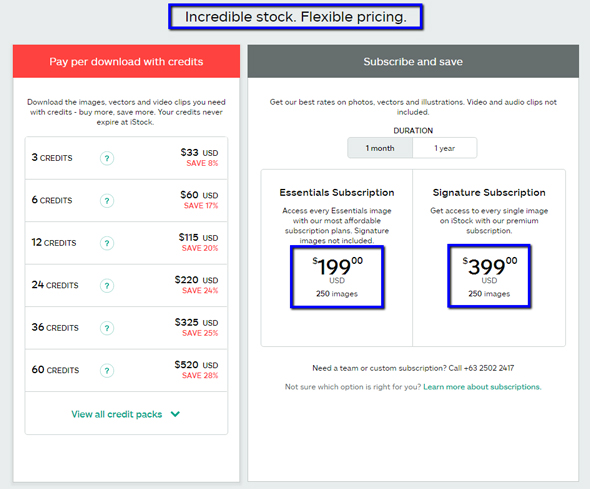
Pay per download with credits. If you need a few images on an occasional basis, iStock gives you the option to pay per download through credits. You can purchase credit packs in various sizes with a minimum of 1 credit and a maximum of 300 credits. A single credit costs $12, but buying more lets you save more. For instance, 3 credits cost $33 and save you $3. Moreover, you do not have to worry about purchasing an excessive amount of credits since they never expire.
iStock Promo Code: Currently, Stock Photo Secrets offers coupons that will give you 10% off on credits. The offer is available to new iStock customers and is applicable to all credit packages.
Subscribe and save. Getting a subscription plan gives you the best rates for iStock photos. You can choose between an annual and monthly plan, Essentials and Signature subscription as well as the number of images included – whichever meets your creative needs. The stock photo website has a new feature that allows you to rollover unused downloads so you do not have to worry about wasted downloads.
iStock Promo Code: Stock Photo Secrets offers coupons that will save you 15% off subscriptions. It is available to all customers – new and existing – and is applicable to monthly subscriptions. iStock coupon codes 2016 will give you 15% discounts on your yearly subscriptions, too. Hurry and redeem them now!
iStock partners with Stock Photo Secrets to make sure all members of the creative community can afford its already affordable stock assets. Aside from the incredible stock and flexible pricing, the stock photo website also offer iStockphoto coupons to further your savings. What are you waiting for? Grab this rare opportunity to get discounts on credits, monthly and yearly subscriptions.












 There has been changes on iStockphoto pricing over the last week and the new prices are in effect now. If you have remaining downloads on your account, they are most likely converted by now. What can you expect with the new pricing and plans? Well, for one, they are a bit pricier now. But before you go out looking for a new primary stock photo website, you should know that they have become more valuable too. How is this possible? Let us count the ways:
 With iStock, you can explore millions of high quality royalty-free stock images, illustrations, music and video clips. You can purchase them by paying per image or subscribing to a plan, whichever suits your creative needs and budget. The stock photo website offers them at ridiculously great prices, and even throws in some coupon codes to further your savings. In previous times, a sign up is necessary to redeem iStock coupons codes but they are now available to both new and existing iStock customers.